
FAQs
- System development charges cannot be legally used on maintenance projects, only capital and primarily only on capacity increasing capital projects (with some exceptions).
- General fund revenues are used primarily for Police, Parks, and Municipal Court. In many cities a public safety utility fee and/or a parks utility fee is in place to help offset these general fund expenditures. Any increase in street funding from the General Fund would need to be offset by a corresponding reduction in the Police Department or Parks Department.
- Staff has also obtained grant funding for some capital projects, but again these monies are not eligible for maintenance or personnel, and are one-time resources that wouldn't solve the problem long-term anyway.
- Lastly, staff has implemented an internal policy to resurface streets in conjunction with any major underground utility projects, for example: The Eckerd and 2nd St project in 2024, and the Lola project starting now.
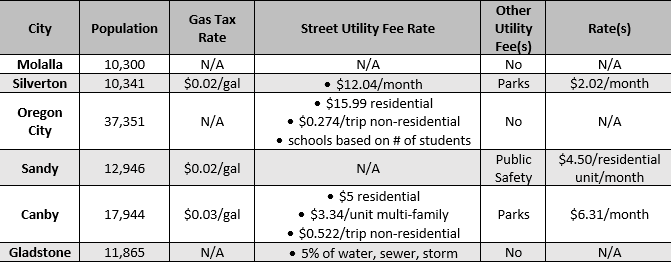
How do other cities pay for street maintenance?
Most cities have a local gas tax, a utility fee, or both. Some cities have utility fees for parks and/or public safety as well. Notably, Molalla does not have a local gas tax or a utility fee of any kind.
How is street maintenance in Molalla funded now?
Molalla's street maintenance funding comes primarily from state gas tax shared revenues.
If a local gas tax and/or street utility fee passed, where would the money go?
All revenues received through a local gas tax or street utility fee would be placed in a dedicated line in the budget and used solely for street maintenance activities such as resurfacing, crack fill and slurry seal, striping, pot holes, etc.
What streets have been resurfaced since the resurfacing program began in 2023?
What steps has Molalla taken to limit costs for street surfacing?
Despite the lack of a dedicated funding source, the city has taken many steps to expand the street surfacing program. All of the dollars saved through the initiatives below are put back into the streets:
1. On-Call paving contract - savings on procurement and contracting costs, and per unit construction costs.
2. Public-Private Partnerships - savings on procurement, contracting, and project management. Also expands the improvement beyond the scope of what the City can require for a development.
3. Public Project Expansion - by including surfacing in pipeline projects, the city reduces the cost to overlay by eliminating setup charges, and offsetting the surfacing project by the cost that would have been charged to fill the trench.